

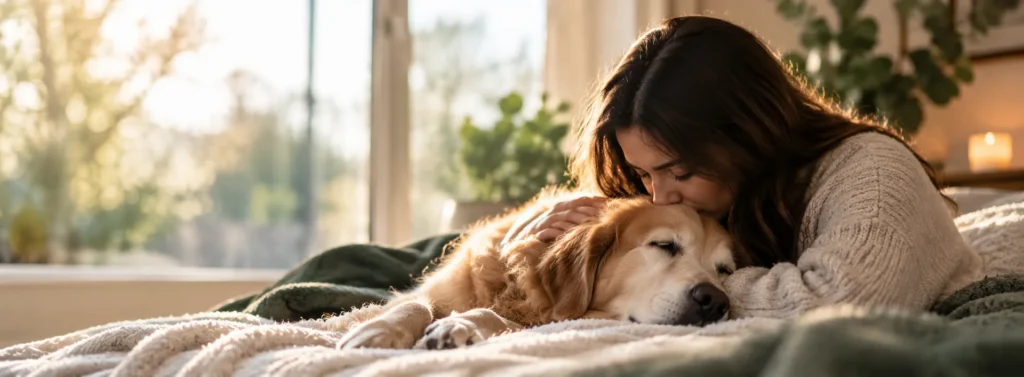
A calm, practical guide for one of the most overwhelming moments a pet owner can face.
| QUICK ANSWER: If your pet dies at home, there is no need to rush. Confirm they have passed, place them in the coolest part of your home on an absorbent towel, cover them gently with a blanket, and call your veterinarian or Pet Meadow – available 24 hours a day – when you’re ready to talk through next steps. |
Losing a pet at home, without the structure of a veterinary office around you, can feel disorienting. One moment you’re going about an ordinary day, and the next you’re facing a loss with no clear next step in front of you. There is no need to rush. As veterinarian Dr. Jennie Rubenstein, a member of the New York State Veterinary Medical Society, has noted, nothing that needs to be done in this moment is urgent – the first thing worth doing is simply acknowledging what you’re feeling. This guide is meant to walk beside you through those first hours, one small step at a time.
1. Take a Moment Before You Do Anything Else
Sit with your pet if you’re able to. It’s normal to feel shock, numbness, guilt, or a strange sense of calm – there is no wrong way to react. Some people feel an urge to immediately busy themselves with logistics; others feel frozen and unable to do anything at all. Both responses are completely normal. You do not need to make any decisions in the first few minutes, and you don’t need to have this figured out before you’re ready.
If there are other people or other pets in your household, it’s alright to give yourself a moment before explaining what’s happened. There is no rulebook for how quickly you’re supposed to move through this, and nothing about the situation requires immediate action beyond simply being present with what has happened.
2. Confirm What Has Happened
If you’re unsure whether your pet has passed, look for stillness, a lack of breathing, and no response to touch. If there’s any doubt at all, contact your veterinarian or an emergency animal hospital right away – they can help confirm and guide your next steps. This is especially important if your pet’s passing was sudden or unexpected, since a veterinarian can also help you understand what may have happened, which can bring a measure of peace even amid the shock.
If your pet had a known, ongoing illness and their passing was expected, you may already feel confident in what you’re seeing. Even so, it’s completely reasonable to call your veterinarian simply to talk it through, or to ask them to confirm over the phone based on what you describe.
3. Prepare Your Pet’s Body
Once you’re ready, place your pet in the coolest part of your home, on a plastic sheet or absorbent towel, and cover them gently with a blanket. This helps preserve their condition until arrangements are made. If aftercare will be delayed more than a few hours, keeping them in a cool space – or refrigerated, if possible – is best. Avoid direct sunlight or proximity to heating vents, both of which can speed up the natural process you’re trying to slow down.
If you have other pets in the home, you may notice them behaving differently around their companion’s body – sniffing, whining, or seeming unsettled. This is a normal response, and many veterinary behaviorists believe it can help other animals in the household process the change, much as it helps grieving humans to have a moment to say goodbye.
4. Reach Out to Us
You do not need to have a plan before you call. Our team is available by phone 24 hours a day to talk through your options, whether that’s transportation from your home, Pet Cremation and Memorialization Services, Witness Cremation, or – at our Hamilton location – a formal burial. Many families call us not with a decision already made, but simply because they don’t know what to do next, and that’s exactly the kind of call we’re here for.
When you call, we’ll ask a few gentle questions – your pet’s size, your location, and whether you have a preference around cremation type – but nothing needs to be decided on that first call if you’re not ready. We can also arrange transportation directly from your home if you’re not able to bring your pet to us yourself.
5. Give Yourself Permission to Grieve
There is no timeline you’re supposed to follow. Some families want to move quickly through arrangements, finding that having a plan brings a sense of control during a chaotic moment. Others need a day or two before they’re ready to make any calls at all. Both are completely normal, and neither is the “right” way to grieve.
In the days that follow, it’s common to feel waves of sadness at unexpected moments – seeing a food bowl, an empty leash hook, or simply the quiet in a room that used to have movement in it. These moments don’t mean you’re grieving incorrectly; they’re simply part of how loss tends to move through us, in its own time and its own way.
“Acknowledge your feelings about that loss. Nothing that needs to be done is urgent.” –
Dr. Jennie Rubenstein, DVM, as reported by TIME
What to Expect When You Call Pet Meadow
We know that picking up the phone in a moment like this can feel like a big first step. Here’s what typically happens: a member of our team will answer, express our condolences, and gently ask a few basic questions to understand your situation and location. From there, we’ll walk you through the aftercare options available at your nearest location, including timing, and can arrange pickup or transportation if that’s easier for you. There is no pressure to decide on the spot, and no judgment for whatever choice feels right for your family.
If Your Pet’s Passing Was Unexpected
An unexpected loss – whether from an accident, an undiagnosed illness, or something that simply happened too quickly to understand in the moment – can carry a different kind of shock than the loss of a pet who had been sick for some time. If this describes your situation, it’s especially important to be gentle with yourself in these first hours. You may find yourself replaying the day leading up to it, searching for something you could have done differently. This is an extremely common response to sudden loss, and it rarely reflects anything you actually did wrong. If those thoughts feel like they’re taking hold in a way that’s hard to shake, our Bereavement Specialist, Alissa, is available to help you work through them, both in these first hours and in the days that follow.
Talking to Other Household Members
If you share your home with a partner, roommate, or children, part of these first hours often involves telling someone else the news, sometimes before you’ve had time to fully process it yourself. There’s no need to have the perfect words ready. A simple, honest statement – “I have some sad news, our pet has passed away” – is enough to start the conversation, and the rest can unfold naturally from there, at whatever pace feels right for your household.